 The Limitless CMO
MAPS Operating System.
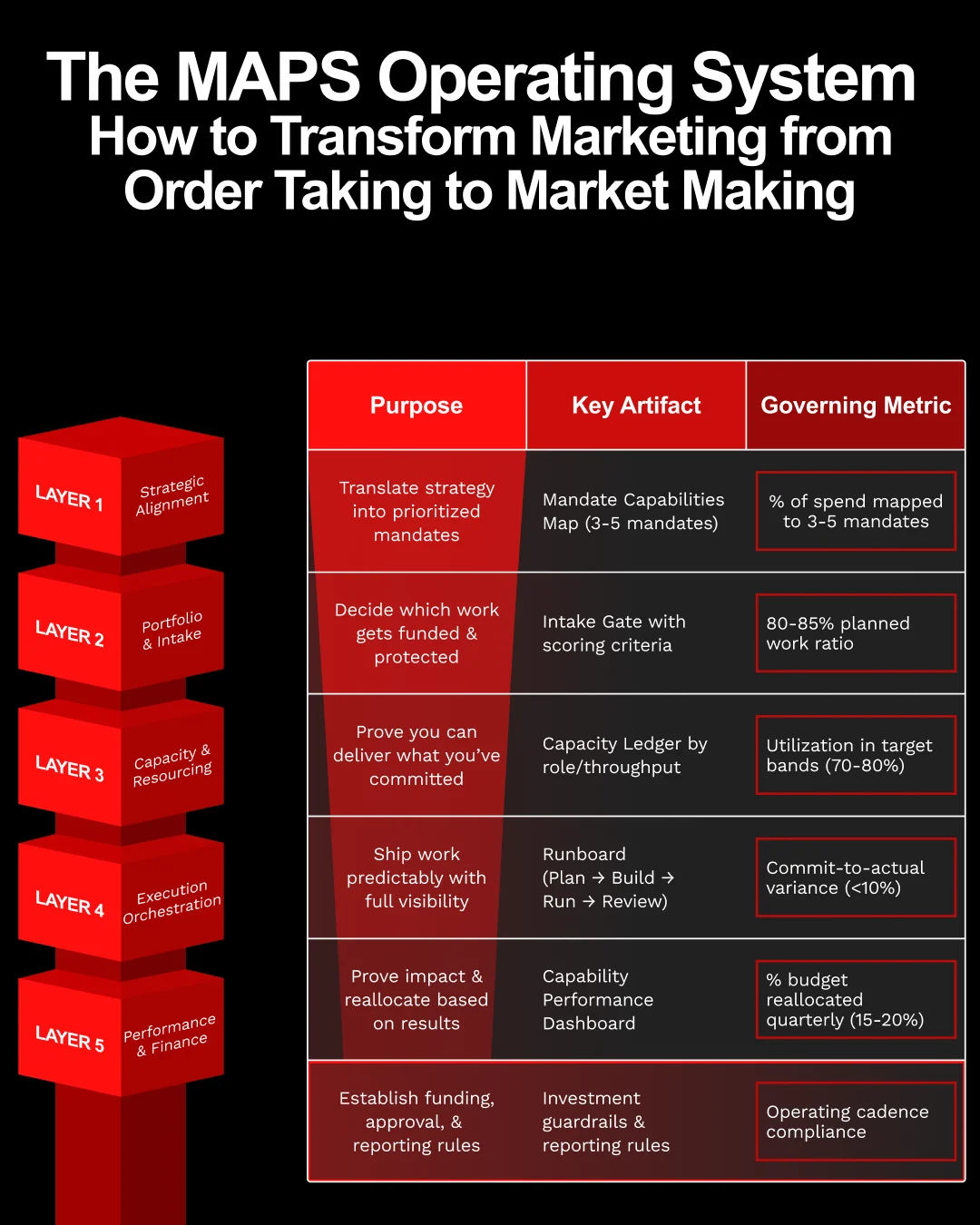
Run marketing like a professional services firm. MAPS, Marketing as Professional Services, is the system that governs how marketing work is planned, funded, executed, measured, and reallocated: five operational layers inside one governance wrapper.
No email required · use it in your own decks
MAPS decides which work gets funded, who does it, and where the money moves next. Every request maps to a growth mandate or it doesn’t get funded. Capacity is tracked like billable hours. Work ships through a four-stage runboard. Budget moves each quarter from underperforming mandates to higher-return ones, under rules that say who can approve what.
- Your CFO treats marketing as overhead.
- Every request gets accepted and strategic work keeps getting deprioritized.
- Executives can’t see what your team is doing or what it delivers.
- Budget stays where it was planned, even when results say move it.
Five layers, one governance wrapper.
Strategic Alignment Through Growth Mandates
Translate business strategy into three to five growth mandates, each with a clear outcome and an accountable owner. Every campaign, initiative, and request maps to a mandate. If it doesn’t support a prioritized mandate, it doesn’t get funded.
- Three to five growth mandates
- Each mandate: outcome, owner, metrics, budget, capacity
- Every request names its mandate, outcome, and success measure
- At least 60% of budget and capacity on the top three
Portfolio & Intake
Decide which work gets funded and protected from ad hoc requests. Every new request is scored 0 to 5 on five criteria: mandate fit, strategic alignment, expected impact, effort, and opportunity cost. Then it gets one of four answers, so every trade-off is visible.
- Five criteria, 0-5 points each
- Answers: Yes, Yes if, Not now, No because
- 80-85% planned work, 15-20% reactive
- Below 80% planned means governance has slipped
Capacity & Resourcing
Prove you have the people and hours to deliver on your commitments. A capacity ledger treats talent the way a consulting firm does: a constrained, high-value asset, allocated intentionally and tracked for utilization.
- Utilization in target bands: 70-80%
- Track hours by growth mandate for four weeks
Execution Orchestration
Connect plan to action with the Runboard, a four-stage workflow that ships work predictably. You always know what’s planned, in progress, and completed. If timelines or spend keep slipping, fix the plan before you push the team harder.
- Plan: scope, outcomes, timeline, resources
- Build: assets, campaigns, programs
- Run: execute and launch
- Review: measure, learn, optimize
- Commit-to-actual variance target: under 10%
Performance & Finance
Prove impact and reallocate based on results. Measure each growth mandate by its contribution to business outcomes. Then move budget in flight from underperforming initiatives to higher-return ones.
- Dashboard: budget, pipeline influenced, payback, status
- Reallocate 15-20% of budget each quarter
- Pull budget from a campaign that misses at 30 days
MAPS Governance
The operating rules and financial discipline that keep all five layers working as one system. Governance sets how the system is funded, approved, reprioritized, and reported.
- Investment guardrails for budget and capacity shifts
- Decision rights: who approves what
- Cadence: weekly, monthly, quarterly, annual reviews
- Executive reporting by mandate: spend, pipeline, payback, ROI
- Start with the two-hour monthly portfolio review
- 03 · Marketing Resource Paradox→
The paradox names the structural trap. MAPS is the operating system that answers it.
- 02 · Limitless Marketing Maturity Model→
The maturity model shows where you are. MAPS is how you move up a stage.
- 14 · Limitless Operating Model→
MAPS is the internal discipline the Limitless Operating Model runs on.
Chapter 4, p. 47 of The Limitless CMO, with the tools that put it to work.